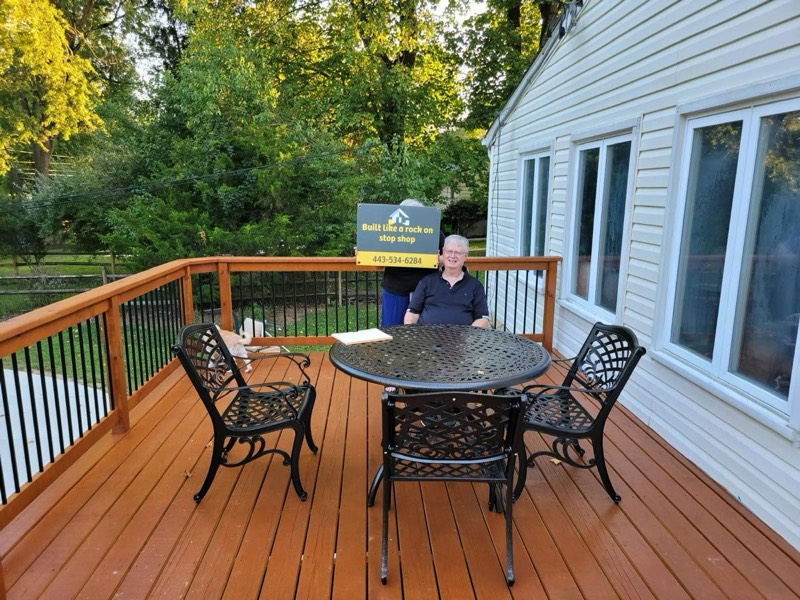
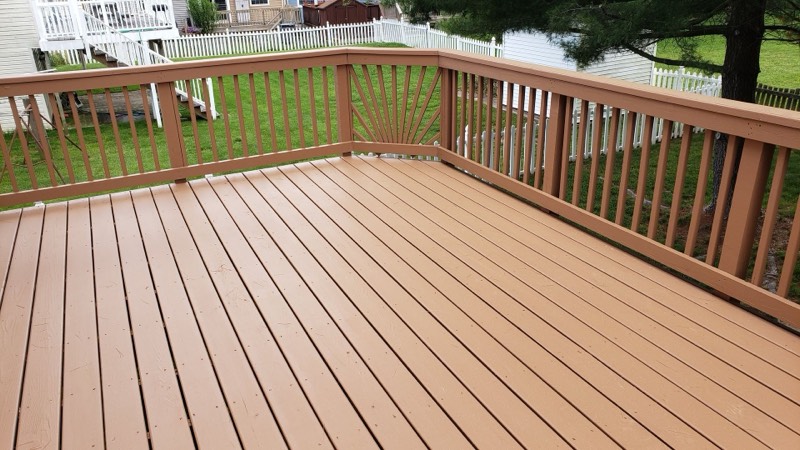
If yes, here's an overview for how we've been building composite decks for people like you across Maryland:
If you're specifically looking for information on repairing your composite deck, give us a call.
Call (443) 534-6284The most important factor in the safety of your deck — and it staying that way. Composite boards sit on the same undercarriage as wood, so this part is just as critical.
If you're in Maryland, you want your deck footing to be 32 inches deep in the ground.
Why? Maryland has a freeze-thaw cycle, and the frost line is 30 inches deep in the ground. If you don't go below the frost line, your footing will be pushed out of the ground and your deck will collapse.
You want to install a metal cleat on the bottom of your posts. That cleat sits on the concrete footing of the deck.
Why? Prevents moisture from wicking up from the concrete into the wood. This prevents rot, which makes your deck last much longer.
You want a notched header across your posts — not just bolted to the face.
Why? To properly distribute the weight across your deck. A notch lets the wood carry the load instead of the bolts and hardware. This avoids unnecessary strain on your posts and joists and prevents early collapse.
For composite decks in Maryland, you typically want 12-inch spacing between joists. You also want galvanized joist hangers.
Why? Composite boards are more flexible than wood and need tighter joist spacing to prevent sagging and bouncing. Most composite manufacturers require 12-inch spacing for their warranty to apply. This is one of the factors that makes composite decks cost more than wood.
Have more questions about the structural integrity of your composite deck?
Call (443) 534-6284The part you see and touch every day. Composite boards don't rot, don't splinter, and don't need staining — but they still need to be installed right.
You want composite boards from a brand that actually holds up — not the cheapest option at the store.
Why? Cheap composite fades, sags, and looks terrible after a few years. Quality composite from brands like Trex or TimberTech holds its color, resists scratching, and won't warp through Maryland's freeze-thaw cycles. CBJ will help you pick the right material based on what you like the look of and what will last.
You want gaps between your deck boards so water runs through instead of sitting on top and soaking in.
Why? Water pooling on composite creates an extremely slick surface, which will cause you to slip and fall. Proper spacing also makes the boards last longer.
You want hidden fasteners for your composite deck boards — not face screws.
Why? It's easier to replace a board if one should break, and it makes your deck look so much cleaner without screw heads showing across every board.
Every county in Maryland has its own permitting requirements for decks. Below is a link to a table that breaks down some of the basic differences in permitting requirements and inspections for decks across the counties we serve.
CBJ Home Improvement was founded by veterans who learned discipline, integrity, and attention to detail long before they picked up a hammer. That military standard is built into everything we do — from how we communicate to how we finish a job.
Fill out the form and we'll get back to you as soon as possible. No pressure, no obligation — just a real conversation about your deck.
Common questions about building a deck in Baltimore. Still have more — just call or send us a message.
Most decks are built in 1–2 weeks once permits are approved. Larger or multi-level decks may take 2–3 weeks. Permit approval timelines vary by jurisdiction in Baltimore County.
Yes. We're responsible for many of the decks across the Baltimore skyline. Bring one of our experts out and they'll tell you what we need to do.
Yes, most decks require a building permit in Baltimore City and Baltimore County. CBJ Home Improvement handles all permit applications so you don't have to worry about it.
No — as long as the dimensions of the deck are maintained and there is no major structural work being done, a repair does not require a permit in Maryland. Replacing boards, railings, and surface-level components is considered maintenance, not new construction.
It varies. We've done decking projects from $6,000 to over $90,000. There are many factors at play, from the types of materials in your deck to the scope of the project. The best way to get a real number is to have us come out and take a look.
No. Power washing forces water deep into the wood fibers, which causes swelling, splintering, and accelerates rot. It also strips the stain and damages the surface of the boards. If your deck needs cleaning, a gentle wash with the right cleaner is the way to go — not a pressure washer.
Yes. We handle the entire permitting process for you. The cost will vary depending on the complexity of the permit process for your specific project, but we take care of all the paperwork and applications so you don't have to.